fbpx

That question, again! (Part II)

The old fashioned way – almost abandoned, today – to rebuff scratched up cases or remove dents or nicks from beat up watches was an invasive procedure that could literally deform the original shape of a watch case, or at best remove forever that particular finish – whether sanded or lapped – that was unique to the factory’s specifications.
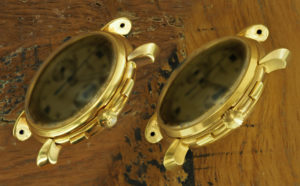
A gold Vacheron & Constantin ref. 4178 chronograph badly polished the old school way and after proper, sensitive case restoration.

To a true lover of watch design like myself this practice was nothing short of sacrilegious and since the very early days of my career I started growing a particular passion for untouched – or barely touched – vintage watches. Only that condition would preserve the purity of the original design that determined the uniqueness of every model. Just like today, however, the buyer’s preference was determined by what the mass – driven by the market – privileged: back then it was the shiny, freshly re-polished watch. Trust me, refusing to re-polish an untouched watch – which I did several times – simply meant losing the sale and having to wait for another day and another buyer. And these clients were experienced, veteran collectors too! Only the least expert would let me decide for them, and accept to maintain their watch’s original condition even if that involved living with a scratch or a small dent on its case. I will keep blood chilling stories of beautiful, original dials refinished because of collectors’ intolerance to a small halo or patina for next time…

Some of my hometown’s biggest names in watchmaking would proudly include in the service a heavy re-polishing job that would often permanently remove all outer engravings, including case serial numbers and brand logos, like the Rolex coronet on snap on case backs. Sadly, even major manufacturers like Rolex and Patek Philippe would return watches with cases that were literally violated as part of the “official” service process, along with replacing original hands, dials and bezels with later replacement parts that would eventually devastate the integrity and value of the vintage piece. But all this for a reason: it was exactly what clients wanted. Slowly, however, things started to change in favor of preservation, and people – gradually absorbing the education offered from a handful of dealers – started appreciating the occasionally rough beauty of an unmolested watch over the glittering allure of the over-polished case. The request to service centers – factory authorized or not – to overhaul the movement without replacing any original visible part and leaving the case be started becoming so frequent, that they had to start considering to change their views on what was right or wrong regarding maintenance.
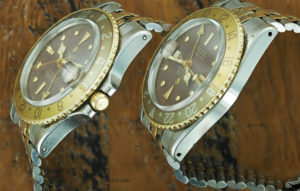
Unpolished Rolex GMT-Master ref 1675

So we arrive to our days, when people on one hand ask: “has the case been polished?” – obviously unable to tell themselves, thus not having a real personal opinion or preference – and watch repairmen or service centers daring not touch a case any longer if they have the slightest hunch they’re looking at an untouched one. Unfortunately there are still a few out there that haven’t got it yet and never will, but they represent a truly sparse minority. In the meantime, however, re-polishing cases has not disappeared as a practice, but has evolved into a new concept that I like to think of as “sensitive” watch case restoration, something that a few extraordinary artisans have brought to a level of a real art. In fact, some incredibly talented hands today are capable of working on a previously devastated case and make it look like it was never touched in the first place. As a matter of fact, as far as I am concerned this is the only case in which this kind of intervention is justified. Different hands and different work styles offer different kinds of results, with a general tendency of the individual artisan to strive for a like-new effect as testimony of his/her professional virtues: I see it a little differently, but that’s something I like to share with my restoration clients only. In the meantime, new collectors keep on worrying about an issue that hardly exists anymore, just like traffic occasionally thickens for hours on a same spot, where there seems to be absolutely no cause for this to happen, other than for an accident happened hours earlier and yet not a single trace of it is still visible. Let me remark this: re-polishing the case of a vintage watch that has never been touched before is a very, very bad idea; likewise, leaving an already badly re-polished one…badly re-polished, is just as stupid, if you have a good opportunity to have it done right.

For Part III, click here.
That question, again! (Part III)

What do we do, now? Keep paying a “never touched” premium to dealers who have learned the way to have their watches perfectly restored for a fraction of that? Or finally learn our own standards and go by those? Is it worth paying other people who will charge us money to tell us NOT to buy based on easily obtainable, public evidence – as that’s the easiest way to make profit at zero risk with zero investment – while exposing us to the same chances of buying a re-polished watch because they couldn’t tell themselves themselves anyway?

Or should we maybe finally accept the fact that what makes a watch truly valuable is its beauty, it’s perfect balance between original condition, organic aging and reasonable wear and tear for the life it has lived, over half a century or more, with no VISIBLE signs of bad restoration attempts to corrupt the picture? Because this is what we are really buying most of the time. And when the unquestionable, history proven, “virgin” condition of a watch is truly available, are we willing to pay the real price, which is three, four or more times the average market? And, do we even need to?

“Let’s stop asking questions the answers to which we would risk using against our own interest anyway; let’s stop allowing dishonest people to make profits by simply lying to our face; let’s stop paying last minute experts a fee for telling us things we could easily figure out by ourselves, as if they made a real difference anyway.”

Conclusion.

With the advent of “preservation” as the new standard, restoration too has changed gear to a point that today’s results were unthinkable just a few years ago. In the meantime, the general public has  only come to understand that a “polished case” is bad, even if just because back in the day “re-polished” meant a violated, vandalized case, awful to look at, even though today that’s really not the case any longer. How does that affect the market? Well, in the first place asking “has the watch been polished?” is likely to possibly provide the enquirer either with a lie or an incorrect answer, unless the watch has been polished by the very person who is offering it, in which case he would know: because in most cases it’s just simply impossible to tell. So, if you really care to know what you are buying, much smarter

Unpolished.

questions would be: “does this watch show evident signs of poor re-polishing work?”, or “what quality score would you give the case on a 1 to 100 scale?”, and “is there any visible restoration attempt that corrupts the watch’s original condition?”. Questions that will more likely get a true answer on which a wise decision can be made. And if somebody tries to sell you the idea that they can tell if a case has been re-polished based on millimeters or milligrams differences, they’re just blowing smoke up your ass: a modern, electronic, numerically controlled milling machine has a tolerance of plus or minus 0,2% for a total potential difference in size of two different examples of the exact same finished product of a 0,4%.

Imagine what are the odds that hand finished parts, cut with analogically operated machinery at least half a century older could deliver anything even close to that “non” precision.

So here’s the deal: let’s stop asking questions the answers to which we would risk using against our own interest anyway; let’s stop allowing dishonest people to make profits by simply lying to our face; let’s stop paying last minute experts a fee for telling us things we could easily figure out by ourselves, if they only made a real difference anyway; let’s start instead developing a personal sensitivity that can finally allow us to make our own decisions, guarantee us that we will love what we are buying and, if we don’t feel technically and professionally prepared to make such decisions on our own, have the humility to go out there and trust a supplier who has the experience, knowledge and taste to make the best possible decision for us.

You guessed it, just like we do when we choose our doctor, interior designer or attorney.

Worn but unmolested: Rolex Milgauss, ref. 6541

Don’t trust blindly those who will always tell you what you like to hear, but try to appreciate and understand the truth. You will find herds of bottom feeders who will volunteer criticizing whatever you are offered from other dealers, and that for sure will protect you from making a bad deal or two. But they will never compensate you for all the good deals they will make you miss either, and that could be just as big, if not bigger, damage; instead, there are a few truly experienced dealers with their own – not yours – skin in the game, who have the experience and knowledge to walk you safely through a true extraordinary experience and, should they ever make a mistake, will not hesitate to own it and stand by it. If you don’t feel confident enough to choose the right watch for you, just try to wisely choose the right dealer: learn about his history, his reputation, his publications – if any – and ask him to help you understand your watch and investment with clarity, standing to his proven experience and not a bunch of controversial information based on online hearsay. Check out what his return policy is, and ask around if he’s known to truly keep his promises.


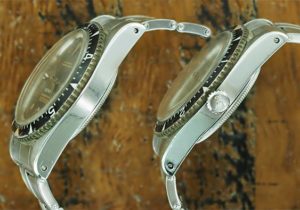
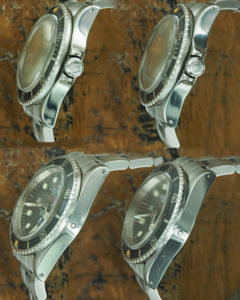
We’ve gone through the phases of watches that would sell only when well re-polished; then, only if with box and papers; then, only if with a “tropical” dial; now, only if “never polished”: what next? Are we ever going to consider watches that just look great enough and that’s it? And by the way, if you are looking at the photos I attached to this post and don’t really see a difference between the properly polished watches and the untouched ones, well…that’s what I’m getting at.